Every piano remembers its own history.
Clients own pianos, and pianos are what you service. So each one gets its own record: make, model, serial, where it sits in the house, every visit, every pitch reading, every issue you have logged and whether it is fixed yet.
Walk into a home you have not seen in a year and know exactly what you said last time.
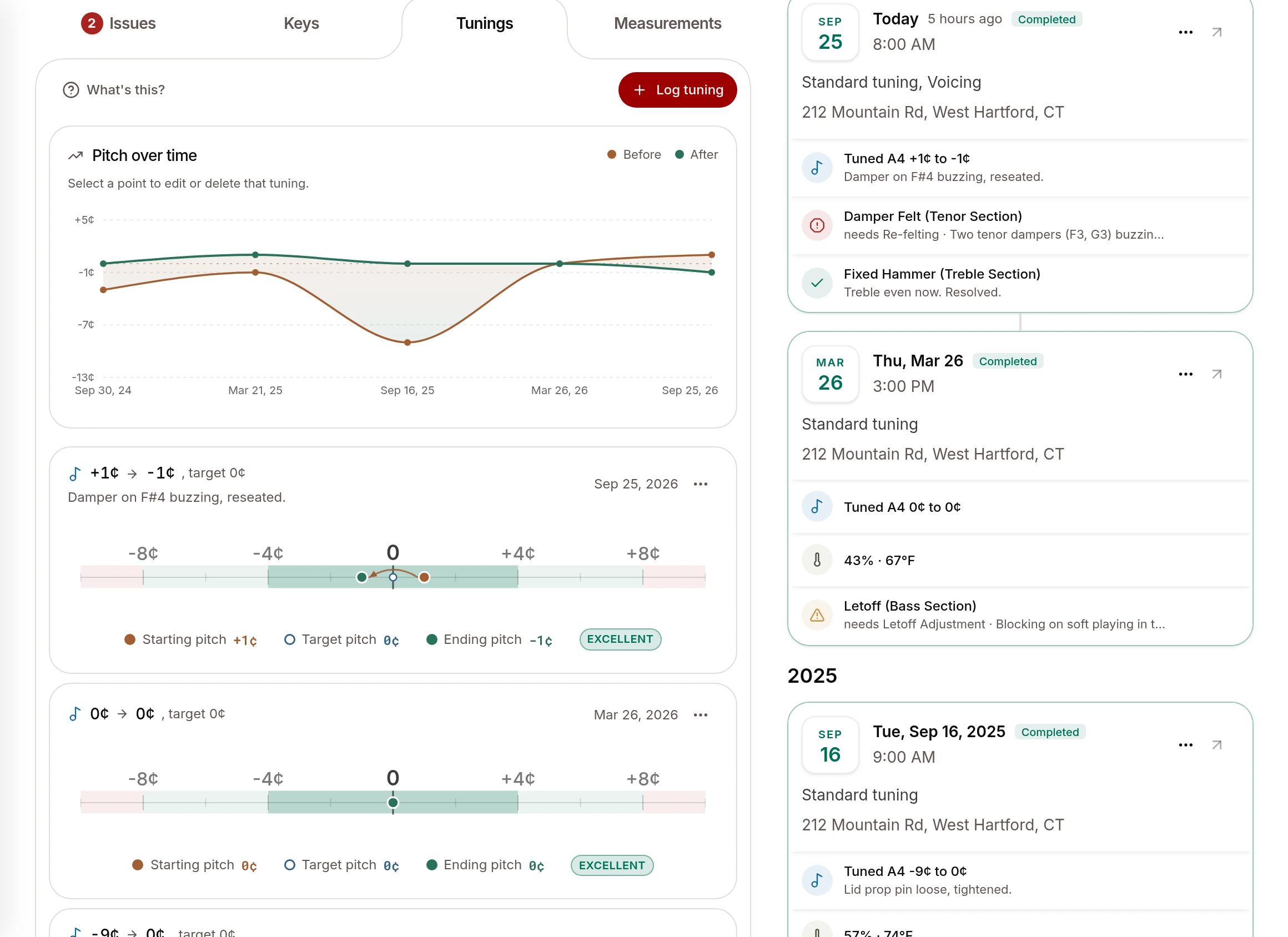
What lives on a piano's record.
The instrument itself
Make, model, serial number, year and type, from spinet and console through every grand size to digital, hybrid and player. Where it sits ("living room, against an interior wall"), and whether it is a rental, on consignment, has a player system or has a humidity control system installed.
When it is due, worked out for you
Set how often a piano tunes and Pianobooker works out the next due date from the last tuning, using real calendar months so a yearly tuning does not drift earlier every year. Log a tuning on a piano with no interval yet and it starts at six months.
Due dates drive the reminders, and you can override a single piano's date whenever a client asks.
Pitch, humidity and temperature at every visit
Log where the pitch started, where you took it and where it ended, in cents from A440, along with the room's humidity and temperature. Over a few visits the piano's record shows how its home is treating it.
Issues that follow the piano
Log a finding against a part, a key or a range like C3 to C5: action, structural or exterior, and whether it is acceptable, needs assessing, adjusting or replacing. Each issue keeps its own history across visits, so you can see when it was found and when it was dealt with.
Condition reports the owner can keep
Pick a date and Pianobooker assembles the report as of that day: the open issues, and optionally the parts by category, a keys overview and the tuning and humidity history with charts. Email it to the owner with a personal note, or download it as a PDF or a spreadsheet.
On a paid plan, Pianobooker drafts the owner-friendly wording for you to review.
History from before Pianobooker
Log a past visit by hand without putting it on the calendar, or bring years of history across from Gazelle. Either way it sits in the same timeline as everything you do from now on.
Sensible defaults, all adjustable.
The tuning interval a piano starts with when you first log a tuning on it.
Before the due date, when the owner gets a reminder to book.
After the due date, the follow-ups if they still have not booked.
Change the interval, the due date or the reminder schedule for any single piano.
Questions & answers
Can one client have several pianos?
How does the client see a condition report?
Can I record history from before I started using Pianobooker?
Do pianos count toward my plan?
Try it on your own clients.
Start on the Free plan with up to 5 clients, no card needed, and move up when your book does. Or talk to Randy about how it would fit your business.